Key points
- The EU has dropped its target of launching ETIAS in the last quarter of 2026 and has set no new date, promising several months of notice before launch.
- Nobody can apply for ETIAS today. A website taking money for it now is not the official service, which lives only at europa.eu/etias.
- The Entry/Exit System has been fully live at French borders since April 10, 2026: passports are no longer stamped, and first-time visitors give fingerprints and a face scan.
- The 90-days-in-any-180 limit is unchanged, but EES now logs every entry and exit electronically, which makes overstays far easier to detect.
Contents
- Why ETIAS still has no start date at the end of 2026
- What will ETIAS cost, and how will the rollout work?
- What to do about ETIAS today: nothing, and avoid paid look-alike sites
- How the Entry/Exit System works at CDG, Orly and other French borders
- What lines at Paris airports look like after the summer
- How to count your 90 days in France and the Schengen area
- What comes next for EES and ETIAS
If you are flying to France from the United States, Britain, Canada or Australia this winter, you still do not need the European travel permit called ETIAS. It has no start date. What you will meet at the border is the Entry/Exit System, or EES, which replaced passport stamps with biometric checks this spring.
The two systems are often confused, and the confusion feeds a market of paid look-alike websites. Here is where each one stands at the end of November 2026, what it means at Charles de Gaulle, Orly and other French borders, and what, if anything, you should do before you travel.
Why ETIAS still has no start date at the end of 2026
ETIAS, short for European Travel Information and Authorisation System, is an online pre-travel check for people who do not need a visa to visit Europe. That includes Americans, Canadians, Australians and Britons. It has been postponed several times since the regulation creating it entered into force in October 2018.
Until recently, the official EU travel portal said the system would open in the last quarter of 2026. That wording has gone.
As The Connexion, an English-language news site based in France, reported on October 17, the portal now only says the system is not running yet. The outlet linked the slip to the technical problems EES ran into in several countries.
The European Commission has not committed to a new timetable. Its Home Affairs page says the EU will announce the specific start date several months ahead. Asked about the delay, the Commission told The Connexion: “Once all conditions are in place, the commission will set a date.”
Press and industry reports now point to 2027 at the earliest. No official text confirms that year.
What will ETIAS cost, and how will the rollout work?
According to the European Commission, the ETIAS fee has been set at 20 euros, up from the 7 euros first planned. That is roughly 23 US dollars.
Travelers under 18 or over 70 will not pay, according to the EU rules relayed by French authorities. Once granted, an authorization is expected to be valid for three years across the 30 European countries that will require it.
The EU also plans a soft start. Official EU guidance describes two stages, each lasting at least six months, before refusals begin:
| Stage | Length | At the border |
|---|---|---|
| Today | Until a date is set | ETIAS does not exist yet |
| Transitional period | At least six months | Entry allowed without ETIAS |
| Grace period | At least six months | First-time visitors may get leeway |
| Full enforcement | After both periods | No valid ETIAS, no boarding |
Put together, the notice period and the two stages mean nobody planning a 2026 or early 2027 trip faces an ETIAS requirement at the border.
What to do about ETIAS today: nothing, and avoid paid look-alike sites
There is no application to file today, no number to keep and no fee to pay. Any site offering to “process” an ETIAS now is either collecting your money for nothing or harvesting your passport data.
In October, the travel association Abta warned that more than 150 websites were offering the service even though the system is not operational. The only official address is europa.eu/etias, and every genuine EU site ends in europa.eu.
- Ignore search ads and emails offering an ETIAS “application” before launch.
- Check that any travel-permit page you visit ends in europa.eu.
- Never share your passport scan with a third-party ETIAS service.
- Watch the official portal for a launch date; the EU has promised months of notice.
Britain’s own ETA, needed by Americans and Canadians flying to London, is a separate system. It has nothing to do with entering France.
How the Entry/Exit System works at CDG, Orly and other French borders
EES is already here. France started phasing it in on October 12, 2025, and it has been fully operational since April 10, 2026 at airports, seaports and land crossings.
It applies to every non-EU national on a short stay, with or without a visa. Britons are included.
Irish citizens are not, because Ireland is in the EU. Holders of a French residence permit or long-stay visa are not registered either.
On your first crossing, a border officer or a kiosk records your name, passport details, the date and place of entry, a photo of your face and your fingerprints. Children under 12 do not give fingerprints. On later trips, the system checks your face or prints against that file instead of creating a new one.
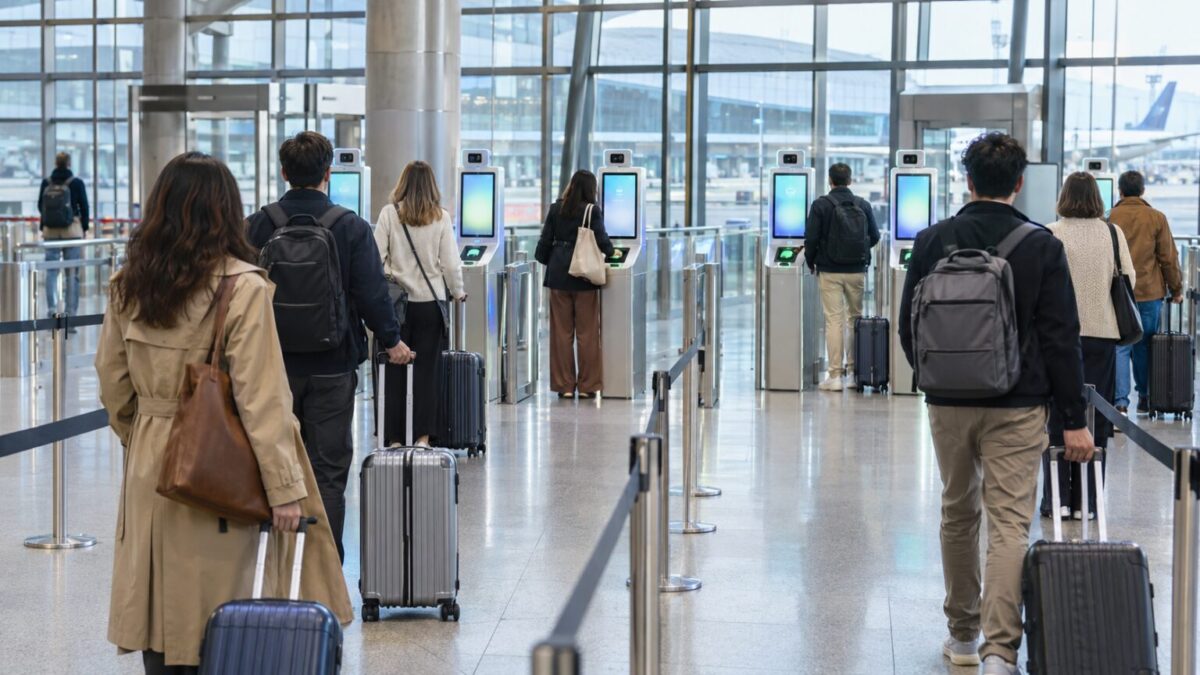
Self-service pre-registration kiosks are installed at Roissy-Charles de Gaulle and Orly. You need a biometric passport, and an officer still validates the file at the booth.
The kiosks have had repeated technical problems in France.
What lines at Paris airports look like after the summer
Paris has been France’s weak point. Over the summer, waits at Paris border checks ran past an hour at busy times, with Charles de Gaulle the most affected, according to reader reports and airline statements gathered by The Connexion in July.
Until early September, France could switch off fingerprint and face capture for up to six hours when lines grew too long. That EU-approved flexibility expired on September 6, 2026. Since then, the biometric steps are supposed to be the norm except during technical breakdowns.
One relief valve has reopened. Americans and Britons who live in France can use the automated PARAFE passport gates again, the government has confirmed, and visitors of the same nationalities may be invited to use them after EES checks where gates exist. Holiday peaks such as Christmas and the February school break remain the times to allow the most margin.
How to count your 90 days in France and the Schengen area
EES does not change how long you may stay. Visitors without a visa can spend up to 90 days in any 180-day period across the whole Schengen area, not just France.
The window rolls. On any given day, look back 180 days and add up every day you spent in Schengen countries, counting arrival and departure days.
If the total would pass 90, you have to leave. A week in Italy and a month in Spain count against the same allowance as your time in Paris.
The European Commission offers a free short-stay calculator on its Home Affairs website. Stamps used to be easy to miscount. EES now does the arithmetic from recorded dates, and an overstay shows up automatically when you leave.
What comes next for EES and ETIAS
The next milestone is the ETIAS launch date itself. Brussels has committed to announcing it months ahead on europa.eu/etias. Launch would then open at least a year of transition before anyone is refused boarding.
For EES, the test is the end-of-year holiday rush, the first peak since biometric checks became mandatory again. Travelers heading to Paris in December should plan on a full biometric check at the border, not a stamp.