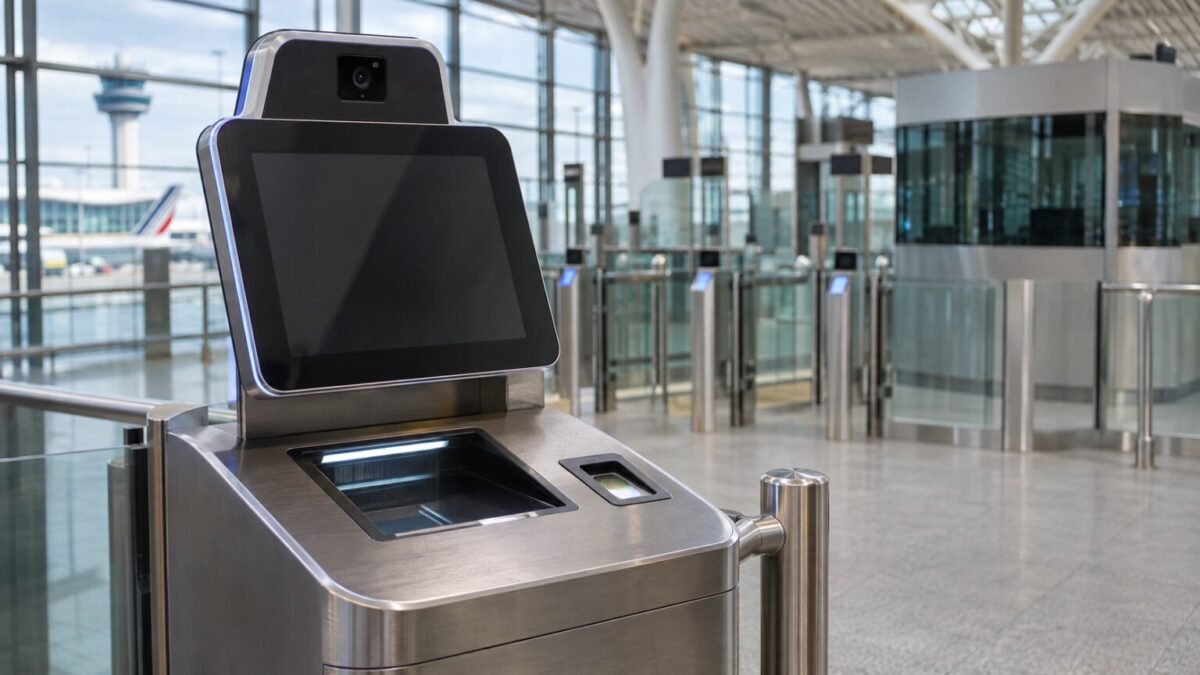
Key points
- EES reached full operation on Friday, April 10, 2026, following its phased introduction at Schengen borders in October 2025.
- Registration happens at border control without an application fee; children younger than 12 do not provide fingerprints.
- For France-bound Eurostar and Dover journeys, French entry checks happen in Britain, before the train or ferry departs.
- ETIAS is a separate online authorization. Check the official European portal before submitting passport information or paying an intermediary.
Contents
Americans, Britons and other short-stay visitors to France face digital border registration under the Entry/Exit System, known as EES. According to the European Commission, the phased rollout began on Sunday, October 12, 2025, and the system reached full operation on Friday, April 10, 2026.
EES records border crossings; ETIAS will authorize eligible visa-exempt travelers before departure. They require different actions.
EES records visitors rather than granting travel permission
EES generally covers short visits by people who are not citizens of the EU, Iceland, Liechtenstein, Norway or Switzerland. That includes tourists carrying American, British, Canadian or Australian passports.
Irish citizens are EU citizens and fall outside that group. Living in Britain does not, by itself, determine which rules apply: nationality and immigration status matter.
The system stores travel-document information, a facial image and relevant fingerprint data, along with entry and exit details. On subsequent crossings, officials normally verify the existing biometric record rather than create an entirely new one.
Residence documents can change the procedure. The British government’s France guidance says long-term residents of Schengen countries are exempt and should carry evidence of their status. Travelers planning to move can consult our French-language guide to French long-stay visas and application requirements.
CDG, Eurostar and Dover use different checkpoints
Where you complete registration depends on your route. These are the practical differences for a direct journey from outside Schengen:
| Route | French border checkpoint | Practical step |
|---|---|---|
| Flight to Paris CDG | On arrival | Follow immigration directions |
| London–Paris Eurostar | St Pancras, London | Complete checks before boarding |
| Dover–Calais ferry | Dover | Follow ferry-operator instructions |
France’s Service Public, in guidance verified April 10, 2026, lists preregistration equipment at Charles de Gaulle, Gare du Nord, St Pancras, Calais and Dover. A kiosk prepares the record; a border officer validates it.
Eurostar says its border formalities happen at the departure station. On a Paris-to-London return journey, that means Gare du Nord, rather than another arrival procedure after reaching Britain.
Use the arrival time on your ticket. A kiosk is not a boarding gate. Completing registration does not remove security or other border checks.
Children need photos, while queues remain variable
Children younger than 12 do not supply fingerprints, according to British and French government guidance. They still have a facial image taken. Accompanied children under 12 may use the kiosks, but unaccompanied children cannot, according to Service Public.
Allow time beyond the biometric scan.
British travel guidance warns that EES can extend border waits, including before a flight out of Schengen.
EES does not increase the usual allowance of 90 days within a rolling 180-day period. Visitors who need a visa can read our French-language explanation of Schengen visa documents and application deadlines.
ETIAS applicants should wait for official opening instructions
The EU’s official ETIAS portal says applications are not currently being collected. Its published target remains the final quarter of 2026; that is not a confirmed opening day.
Once available, authorization will generally last three years, or until the linked passport expires. The announced application charge is €20, with fee exemptions for applicants under 18 or over 70.
Do not treat 96 hours as guaranteed approval. The EU says many decisions take minutes, but cases requiring further checks can take longer.
- Start at the official portal, travel-europe.europa.eu, rather than a sponsored look-alike.
- Confirm that applications have opened before entering personal details.
- Check the applicable transition rules and apply before your planned journey once instructed.
The EU plans an initial six-month transition during which travelers should apply but entry without ETIAS remains possible under the applicable conditions. The official launch announcement will establish when that period begins.