Key points
- From Sunday, Dec. 13, 2026, SNCF bars fatbikes, bikes over 185 cm long or with tires wider than 6 cm, gyropods and hoverboards from TGV INOUI and Intercités trains.
- A regular bicycle can still ride fully assembled in a reserved bike space, for €10 (about $11) per bike and per trip on TGV INOUI.
- A folded bike, or one taken apart and packed in a bag no bigger than 90 x 130 x 50 cm, still travels free and needs no booking.
- Luggage that breaks the rules costs €50 per item, capped at €150 (about $170), and recharging any battery on board is forbidden.
Contents
France’s national rail operator is shrinking the list of two-wheelers allowed on its long-distance trains. Starting Sunday, Dec. 13, 2026, fatbikes and oversized bicycles will be refused on TGV INOUI and Intercités services, along with Segway-style gyropods and hoverboards, according to Service-Public.fr, the French government’s official information site, which announced the change on Oct. 28.
The new rule matters most to cycling tourists, exchange students and expats who use the train to reach France’s bike routes. The bans apply to two specific services. TGV INOUI is SNCF’s standard high-speed brand, linking Paris to cities such as Lyon, Marseille, Bordeaux and Strasbourg. Intercités are slower, state-backed long-distance trains on conventional lines, such as Paris to Toulouse via Limoges.
What SNCF bans on TGV INOUI and Intercités from Dec. 13
The new limits come down to three numbers: two wheels, 185 cm (about 6 ft 1 in) in length and 6 cm (about 2.4 in) of tire width. Any bicycle that exceeds one of them stays on the platform.
That rules out fatbikes, the wide-tire models that have become popular in beach towns and on snowy trails. It also excludes any cycle with more than two wheels. These types were already off-limits before the change: recumbent bikes, tricycles, cargo bikes, longtails, tandems and trailers.
Electric scooters are partly affected. Models with a seat or more than two wheels, models that do not fold and models with tires wider than 6 cm will no longer be accepted, reports Que Choisir, the French consumer magazine.
SNCF told the magazine the move answers safety concerns and the need for passengers to move freely inside the cars. Bulky items also slow down boarding and hurt punctuality.
Which bikes and scooters can still board a TGV?
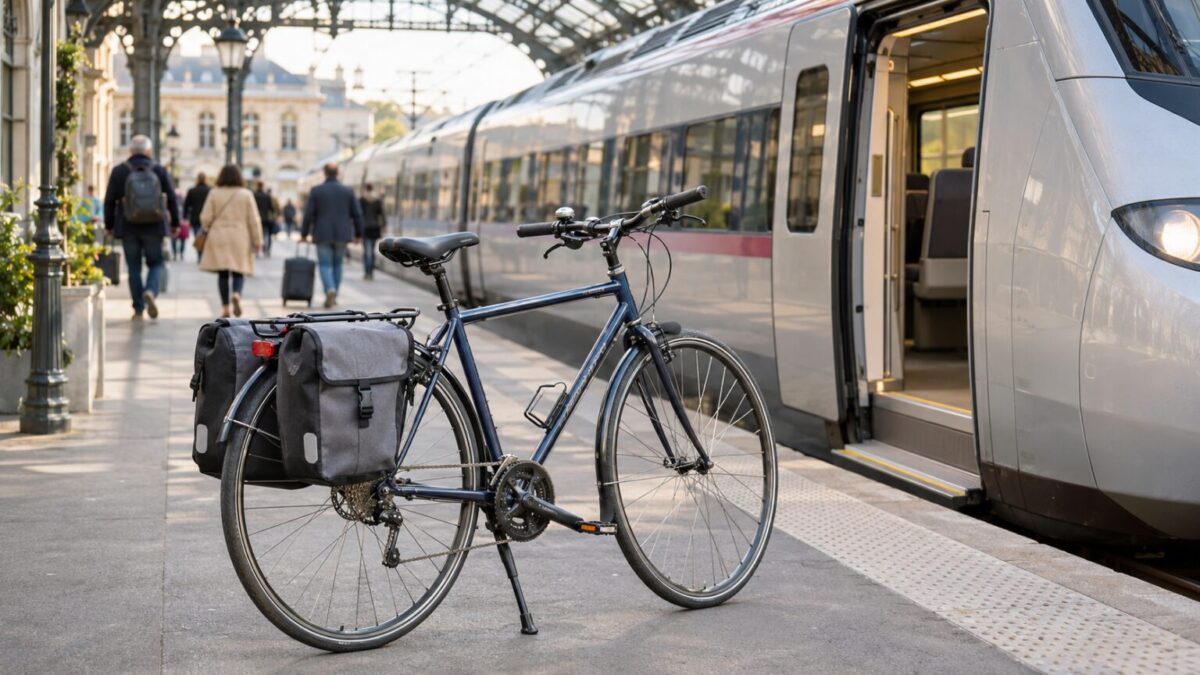
A regular bike remains welcome on TGV INOUI, in two ways. You can bring it assembled, in a dedicated bike space that must be booked with your ticket. Or you can fold it, or take it apart, and carry it in a bag that does not exceed 90 x 130 x 50 cm (roughly 35 x 51 x 20 in). The second option is free and needs no reservation.
Folding scooters still count as ordinary luggage if they fit the same 90 x 130 x 50 cm limit once folded. An SNCF spokesperson told Que Choisir that one-wheel electric unicycles remain accepted, with no change planned.
The table below sums up the rules on TGV INOUI and Intercités after Dec. 13.
| Item | Allowed after Dec. 13? | Condition |
|---|---|---|
| Standard bike, assembled | Yes | Booked bike space, paid |
| Folding or dismantled bike | Yes | In bag, 90 x 130 x 50 cm, free |
| Folding e-scooter | Yes | Folded, within 90 x 130 x 50 cm |
| Electric unicycle | Yes | Unchanged rules |
| Fatbike, bike over 185 cm | No | New ban |
| Gyropod, hoverboard | No | New ban |
| Cargo bike, tandem, trike, trailer | No | Already banned |
How much does a bike cost on each type of French train?
Prices depend on the service, and the new ban covers only two of them. Dollar figures below are approximate.
On TGV INOUI, an assembled bike costs €10 (about $11) per bike and per trip. On Intercités, the fee is €10 on lines such as Paris-Limoges-Toulouse and Paris-Clermont-Ferrand, and €5 (about $6) on some other lines, according to SNCF’s own pages.
Ouigo, SNCF’s low-cost brand, has its own rules. On its high-speed trains, a bike must be folded or taken apart in a bag of up to 90 x 130 x 50 cm, for €5. On the slower Ouigo Train Classique, an assembled bike costs €10 and a folded one €5, within the spaces available.
TER regional trains, run by SNCF on behalf of France’s regions, often carry bikes free in dedicated spaces. Rules vary from one region to another, and SNCF Connect, the operator’s booking site, notes that some regions charge a small fee or require a booking.
In the Paris region, Transilien commuter trains carry bikes free on weekdays before 6:30 a.m., between 9:30 a.m. and 4:30 p.m., and after 7:30 p.m. Weekends and public holidays have no time limit, but staff can refuse a bike when trains are full.
| Train | Assembled bike | Folded or bagged bike |
|---|---|---|
| TGV INOUI | €10 (~$11), booking required | Free |
| Intercités | €5 or €10 by line | Free |
| Ouigo high-speed | Not accepted | €5 (~$6) |
| Ouigo Train Classique | €10 (~$11) | €5 (~$6) |
| TER regional | Often free, region rules | Free |
| Transilien (Paris area) | Free off-peak | Free off-peak |
Batteries and fines: the €150 risk
E-bike riders face one more restriction. SNCF forbids recharging batteries on board, even batteries detached from the bike or scooter, citing the fire risk from lithium cells.
Breaking the luggage rules on TGV INOUI and Intercités costs €50 (about $55) per non-compliant item, up to €150 (about $170), according to Service-Public.fr.
A checklist for cycling travelers before booking
- Measure your bike: length under 185 cm, tires no wider than 6 cm, two wheels only.
- Choose your option: a paid bike space for an assembled bike, or a free spot as luggage if folded or bagged.
- Book the bike space with your ticket on TGV INOUI and Intercités, since spaces are limited.
- Check the bag size: 90 x 130 x 50 cm maximum.
- Charge e-bike and scooter batteries before leaving, since charging on board is banned.
- For regional legs, look up the TER rules of the region you are riding through.
- Around Paris, plan Transilien trips outside weekday rush hours.
The new rules take effect on Dec. 13. Travelers who already hold tickets for later dates with an oversized bike will need to switch to a folding or bagged bike, or check the TER and Ouigo rules for their route before that date.