Key points
- Since Monday, Nov. 23, 2026, SNCF’s new TGV M has run one daily round trip between Paris and Nice, two weeks after Marseille opened.
- Only six trainsets were in service in late November, so your chances of getting one on a random booking are still small.
- Tickets cost the same as any TGV INOUI: there is no separate TGV M fare and no surcharge for the new train.
- Top speed stays at 320 km/h, so trips from Paris to Marseille or Nice take no less time than before.
Contents
France’s next-generation high-speed train, the TGV M, now carries paying passengers on two of the country’s busiest tourist routes: Paris to Marseille and Paris to Nice on the Riviera. The first official run left Paris Gare de Lyon at 9:56 a.m. on Friday, Nov. 6, 2026, and regular service started on Monday, Nov. 9.
This guide is for travelers and expats who book SNCF trains. It covers whether the new train is worth chasing, how to tell if your train is one, what changes on board and what stays the same.
Where the TGV M runs today, and how often
The rollout is slow. At launch, Marseille had a single daily round trip, running as two coupled trainsets with 1,240 seats in total. Nice was added on Monday, Nov. 23, according to Journal du Geek.
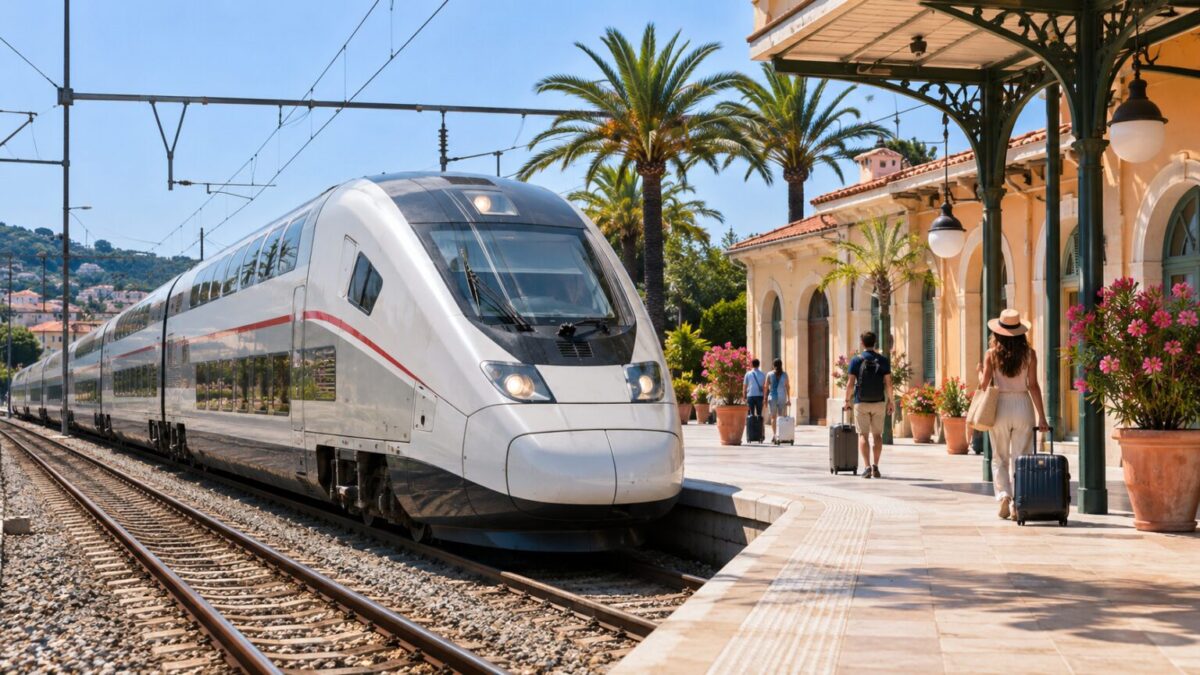
On the Riviera route, SNCF has assigned the new trainsets to specific trains: the TGV INOUI that leaves Paris Gare de Lyon at 10:10 a.m. for Nice, and the return that leaves Nice at 4:56 p.m. The trip to Nice takes about six hours. Paris to Marseille takes a little over three hours on the fastest services.
One warning: SNCF decides which trainset runs which service, and it can swap them for maintenance or operational reasons. A train that is a TGV M this week may not be one next month, so check again when you book.
How many TGV M trains are there?
Very few. Journal du Geek reported six trainsets in service in late November, and SNCF hopes to reach 12 to 14 by the end of the year. Alstom, the French manufacturer, gave a target of 13 trainsets by the end of 2026 in its own delivery calendar.
SNCF CEO Jean Castex has set a goal of about 12 to 13 daily round trips in the southeast in early January 2027, as reported by L’Echo touristique, a French travel-trade publication. The Alps, including the ski station of Bourg-Saint-Maurice, are next on the list for 2027.
More than 100 trainsets are on order. The full fleet will replace older TGVs gradually, over roughly a decade, so most TGV journeys in France will still run on the familiar double-deck Duplex trains for years.
Does the TGV M cost more?
No. There is no TGV M ticket to buy. The new train is sold as an ordinary TGV INOUI, SNCF’s standard high-speed service (as opposed to OUIGO, its low-cost brand). For the commercial launch, SNCF calls it the TGV Nouvelle Génération, or New-Generation TGV, rather than TGV M.
Jean Castex said at the launch that the new train would have no effect on prices, up or down. Fares follow the usual TGV INOUI dynamic pricing: cheaper when you book early, more expensive close to departure and at peak times.
Booking through the official SNCF Connect app or website is the simplest option. SNCF usually opens TGV sales about four months ahead, and the cheapest Prem’s fares tend to go first.
How to tell if your train is a TGV M
There is no official label at the time of booking, and no filter in the app. French outlets have reported two unofficial tips, both based on what the booking screens show.
- Look for autonomous wheelchair access. Journal du Geek suggests opening the trip details in the SNCF Connect app and looking for a mention of autonomous wheelchair access. The TGV M is the only TGV INOUI with a built-in lift that lets wheelchair users board without staff help.
- Check car 3 on the seat map. The French transport site transportdepersonne.com recommends selecting first class, opening the seat map and looking at car 3. On a TGV M, it is a single-level car with a large accessible restroom.
- Check the train number. If you want to maximize your chances, book the 10:10 a.m. Paris-Nice departure or its 4:56 p.m. return, or the Marseille round trip, and confirm the train number before you pay.
- Look at the train on the platform. This is the only sure check. The TGV M has a rounded, flatter nose, a mostly white body and long, low windows, unlike the boxier Duplex.
None of these tips comes from SNCF, and they may change as the app is updated.
What is actually different on board
The upgrades are real but modest, and you will notice the second-class seats first. They offer up to 5 cm (about 2 inches) more legroom than the previous generation. Seat width is unchanged at 45 cm, according to Journal du Geek, and each seat has its own power outlet.
The biggest change is the food car. The old staffed bar has been replaced by a self-service shop with automatic checkout. You pick a meal, pay at the machine and heat it yourself in a microwave. Upstairs, a 28-seat lounge area lets you eat or work with a view.
The other practical gains:
- Luggage space up by about 20% compared with current trains.
- Spaces for eight bicycles carried fully assembled, with no need to dismantle or bag them.
- 573 seats in the TGV INOUI layout, against 556 on the previous generation, and up to 740 in the high-density layout planned for OUIGO.
- The integrated lift for wheelchair users.
Alstom says the design uses 20% less energy and cuts CO2 emissions by 32% compared with previous trains. Those are the manufacturer’s own figures.
What the TGV M does not change
Speed is the main disappointment for anyone hoping for a faster trip. The TGV M tops out at 320 km/h (about 199 mph), the same as the trains it replaces, so it saves no time on Paris-Marseille or Paris-Nice. Journey times depend on the tracks, not the train.
Prices stay the same, as do the booking channels, the classes (first and second) and SNCF’s standard rules on tickets, exchanges and refunds. If you book a TGV INOUI and get an older Duplex, you have not lost anything you paid for.
Why France waited so long for its new TGV
The TGV M was first meant to carry passengers during the Paris 2024 Olympics. The launch was then pushed back several times while SNCF and Alstom finished testing. The European Union Agency for Railways (ERA), which certifies trains for the EU market, gave it final marketing authorization on May 29, 2026, after almost 1 million kilometers of test runs.
Even after that green light, the planned start in early September 2026 slipped again, to November. Each trainset costs about 35 million euros (roughly $40 million), paid for by SNCF.
Is it worth seeking out?
For most visitors, no. Book the train that fits your schedule and budget, because the old TGV Duplex will get you there just as fast. If you are a rail enthusiast, travel with a bicycle or use a wheelchair, the 10:10 a.m. Paris-Nice train or the Marseille round trip is worth targeting while the fleet is small.
The odds should improve quickly. If SNCF meets its target of 12 to 13 daily round trips in early 2027, the new train will become a common sight between Paris, Lyon, Marseille and the Riviera, before it heads to the Alps later in the year.